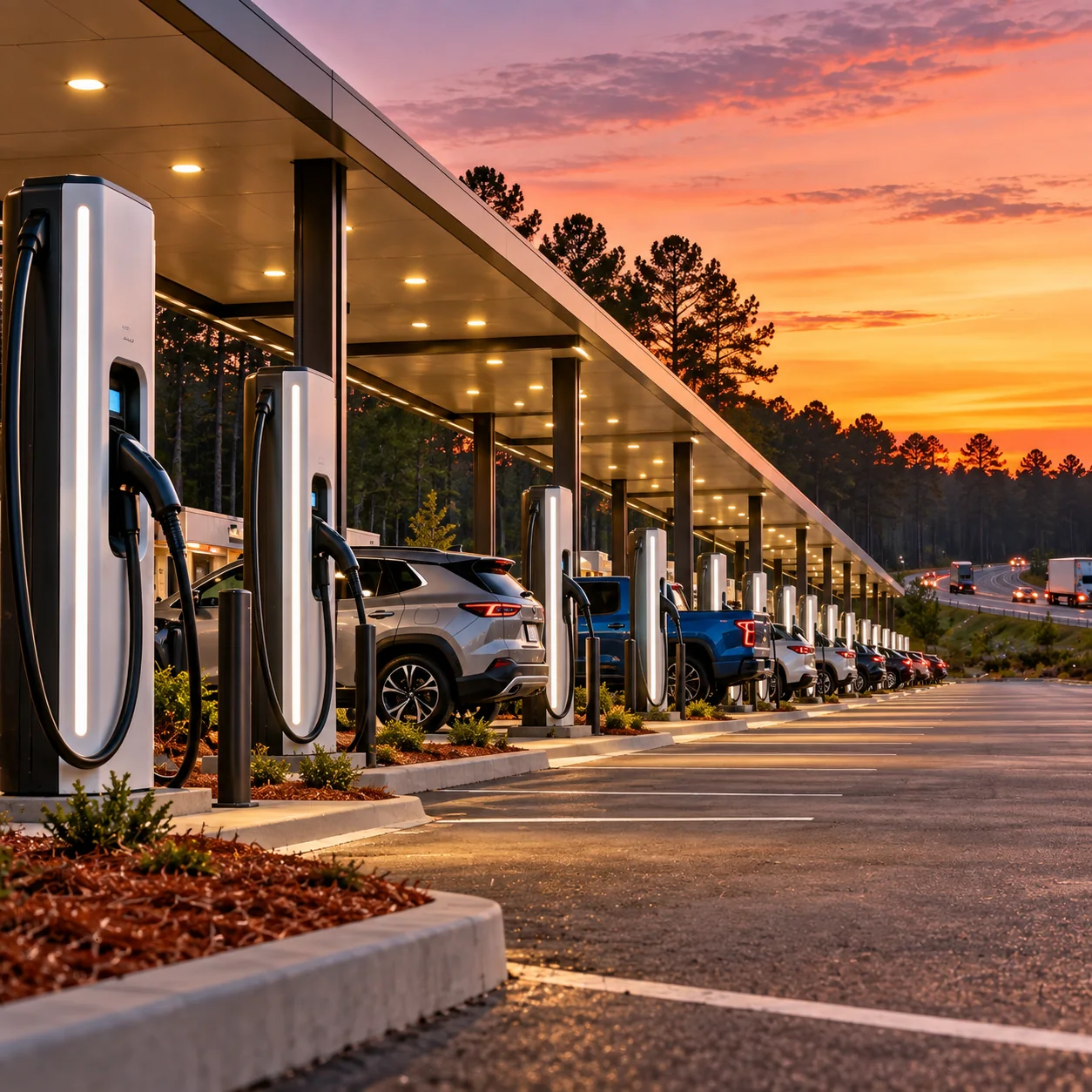
Ionna has passed 1,500 fast charging stalls.
As of September 12, the network founded by eight automakers was operating 1,526 DC fast charging stalls across 178 locations in the United States, according to an analysis of Alternative Fuels Data Center figures by EVChargingStations.com. In late March the count was 1,000 stalls at 100 locations. That is 526 stalls, or 50 per cent growth, in about six months, and the network doubled in size in seven.
The number matters less than how the network got there. Ionna is growing quickly while keeping its sites large, its chargers fast and its prices low. A month before the milestone, it also took first place in J.D. Power’s satisfaction ranking. Many in the industry have assumed that charging networks have to trade speed of rollout against quality. Ionna’s numbers argue against that.
A Network Built to One Specification
Every one of Ionna’s 1,526 stalls can deliver up to 400 kW of peak power, and the network averages 8.5 stalls per location, according to EVChargingStations.com. That makes it the leader in the 400 kW and above segment. It now ranks as the eighth largest DC fast charging provider in the United States by port count and could move up to fifth within months.
Connectors tell the same story. About 548 stalls, roughly 36 per cent, have NACS connectors, against an industry average of around 12 per cent. Ionna’s average price of $0.38 per kWh is well below the industry average of $0.56, and several of its founding carmakers offer further discounts of 10 to 20 per cent.
BMW Group, General Motors, Honda, Hyundai, Kia, Mercedes-Benz, Stellantis and Toyota own the venture. Because the owners build the cars, the network can be designed around what their customers will plug in over the next decade.
Convenience Retail Became the Growth Engine
Most of the recent openings come from Ionna’s partnership with Circle K. When the deal was announced in April, the two companies set a target of more than 350 Ionna Rechargeries at Circle K locations. That includes upgrading 85 existing Circle K charging sites from 180 kW to 400 kW and building more than 265 new ones on Alpitronic HYC400 hardware with both NACS and CCS1 connectors.
This deal also gives the story its Canadian connection. Circle K is owned by Alimentation Couche-Tard, which is headquartered in Laval, Quebec. Instead of building and running a charging business alone across its U.S. stores, a Canadian convenience retailer has partnered with a specialist operator that already brings high-power hardware, software and automaker demand.
The location choice holds up. In J.D. Power’s 2026 study, chargers at gas stations and convenience stores scored 689, close behind hotels and restaurants. Those sites already have the parking, lighting, restrooms and food that drivers want during a 20 minute stop.
Satisfaction Is Now a Competitive Metric
Electrek reported on August 13 that Ionna led J.D. Power’s 2026 U.S. Electric Vehicle Experience Public Charging Study for DC fast charging with 807 points out of 1,000. The Mercedes-Benz Charging Network came second with 797 and the Rivian Adventure Network third with 755. The study surveyed 6,594 EV owners between January and June.
The rest of the industry is improving too. Average DC fast charging satisfaction rose 12 points to 666. The share of visits where a driver could not charge fell to 12 per cent, from 14 per cent a year earlier. J.D. Power noted that the newer automaker-backed networks scored especially well on ease of charging, charging speed and charger availability.
That changes what investors should ask about a network.
How many stalls does it have?
How many of those stalls work for the driver the first time?
What the Model Means for Operators and Site Hosts
Ionna’s progress offers a playbook that applies well beyond its own network, including to Canadian operators building with ZEVIP and provincial support. The lessons are practical:
- Build fewer, larger sites rather than many two-stall installations
- Specify for the next vehicle generation, not the current fleet average
- Make NACS standard from day one instead of adding it later
- Partner with retail hosts that already have traffic and amenities
- Treat pricing as a reason to choose the network, not only a revenue line
- Track successful sessions as closely as installed ports
For utilities, the shift to 400 kW sites with eight or more stalls means larger and more predictable service requests. Planning them alongside retail host networks, instead of one site at a time, could shorten connection timelines considerably.
The Harder Part Is Still Ahead
Ionna is aiming for 30,000 DC fast charging stalls by the end of 2030. EVChargingStations.com estimates that will take about 7,000 new stalls a year, several times its current pace. The Circle K pipeline, with the first Rechargeries due by the end of 2026 and more scale planned for 2027, is the clearest route to that faster build rate.
Canada is part of the longer plan. When Ionna began operations in February 2024, it described its 30,000 stall target as a North American network and said it planned to expand into Canada at a later stage. Canadian drivers on cross-border routes already benefit from a denser, more reliable U.S. network. A future Canadian rollout would arrive with a proven site format, an established retail partner with Canadian roots and the automaker customer base already in place.
That makes execution the variable to watch. Keeping first-place satisfaction while building several times faster is a different test from reaching 1,500 stalls.
For eight automakers, Ionna started as a way to hedge their charging risk. By September 2026 it had become the standard other networks are judged against.