Electric trucking’s charging problem is starting to look like a real estate business.
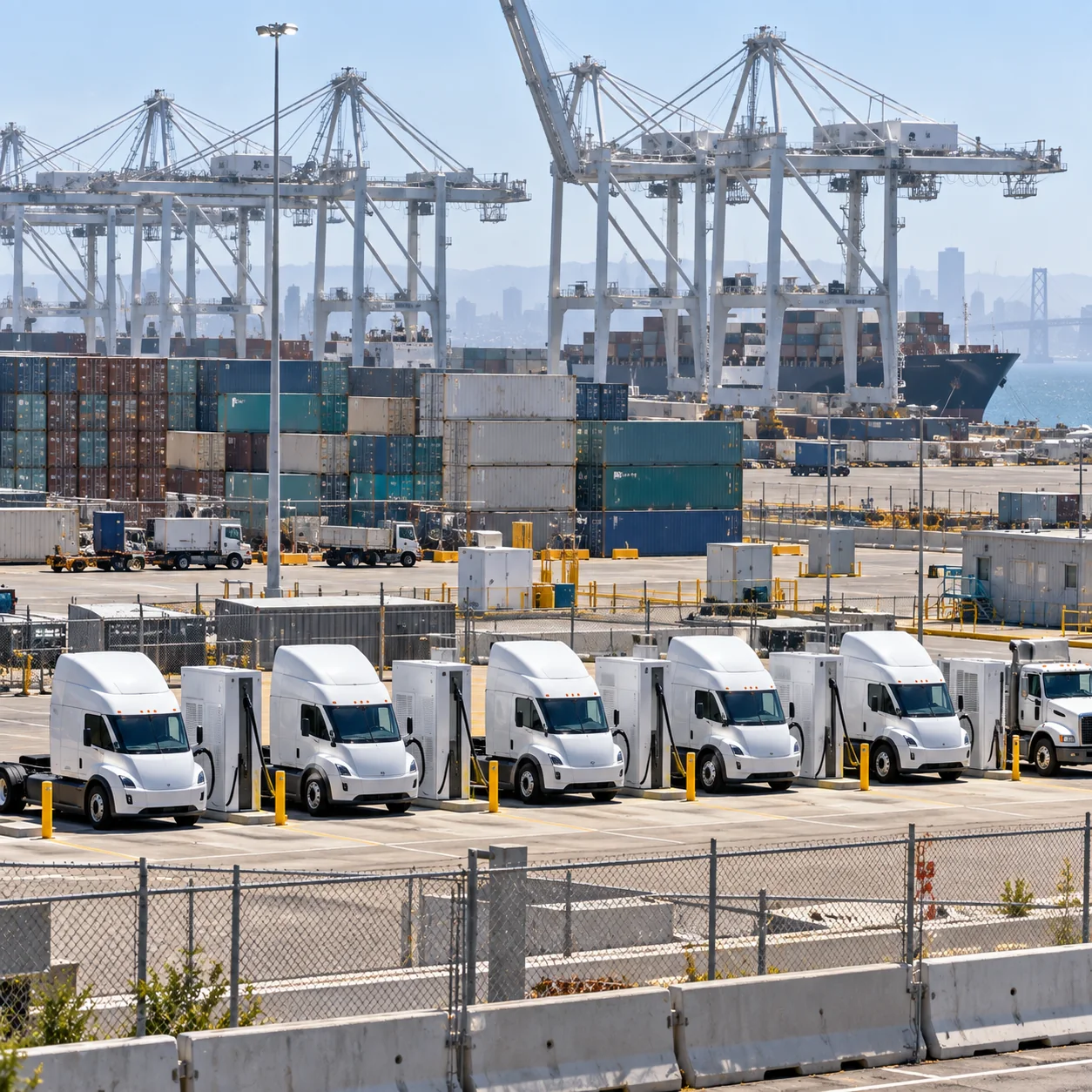
On September 17, Forum Mobility announced four new electric truck charging depots in California that will add 30 MW of heavy-duty charging capacity to its network. Tesla will operate public Megacharger sites at three of them: FM Francis in Ontario, California, and FM Adeline and FM Coliseum in Oakland. At the fourth, FM Santa Fe in Rancho Dominguez, Forum has contracted fleet capacity for more than 330 Tesla Semis while keeping the depot open to other commercial carriers.
The capacity is the headline. The structure is the story. Forum owns the sites, Tesla runs the high-power charging at three of them, and carriers lease trucks and buy access to energy instead of building depots of their own.
That division of labour may be what heavy-duty charging needed to scale.
A Depot Network Built Around Freight Rather Than Highways
Forum says it now has more than 40 MW of CCS and MCS charging capacity online or under construction, with 25 carrier customers holding contracted capacity. Its first site, FM Harbor at the Port of Long Beach, has operated since December 2024 with 44 CCS ports and 9 MW of capacity. The company has now added two Tesla MCS Megachargers there as well.
The new depots use pull-through lanes, so drivers can charge without detaching a chassis. That sounds like a small design choice. In drayage, where trucks shuttle containers between terminals, rail yards and warehouses several times a day, it decides whether a charging stop fits the shift. Forum says its Megawatt Charging System units add up to 60% of range in about 30 minutes.
The site selection is just as deliberate. Oakland and the Long Beach area are port gateways. Ontario, California sits in the Inland Empire warehouse belt. These are places where short-haul trucks run predictable loops and can be scheduled around charging windows, which is exactly where battery-electric Class 8 trucks make the strongest case today.
Tesla Is Growing a Truck Network Without Buying the Land
For Tesla, the arrangement extends the Megacharger network through a partner. Electrek reports that Tesla manufactures and operates the charging equipment while Forum owns the real estate, and that Tesla has 66 planned Megacharger locations on its map. According to Electrek, Tesla sells Megachargers for $188,000 and charges $0.08 per kWh on third-party charging sites.
The pattern will look familiar to anyone who has followed light-duty charging, where hardware providers, network operators and site owners increasingly split the work. In trucking the split matters even more. The charger is rarely the hardest part. The hard parts are industrial land near freight nodes, multi-megawatt utility interconnections and permits, and those take years to assemble. Forum has been doing that assembly. Tesla brings hardware, software and a large truck customer base.
Each party carries the piece of the problem it is best equipped to solve.
Charging as a Service Lowers the Bar for Carriers
Forum describes its business as pairing affordable electric truck leases with reliable charging through depots along key freight corridors and port-adjacent areas. For a small or mid-sized drayage carrier, the alternative is a private depot: land, an electrical upgrade and a utility timeline that can outlast the business case. A shared depot turns that capital project into an operating cost.
“The highly favorable total cost of ownership for battery-electric class 8 trucks has driven rapid motor carrier adoption,” said Matt LeDucq, CEO and co-founder of Forum Mobility.
Public funding helped build the platform. Forum lists support from the Bay Area Air Quality Management District, the California Energy Commission, the California Transportation Commission, Caltrans, LA Metro, the South Coast Air Quality Management District and Southern California Edison. Air districts, state agencies and the utility each absorb a share of the early risk, and that layered approach is how first-of-kind freight infrastructure gets financed.
For developers and fleets weighing a similar model, the Forum sites point to a clear checklist:
- Proximity to ports, rail yards and distribution centres
- Pull-through lanes sized for tractor and chassis combinations
- A mix of MCS and CCS to serve current and next-generation trucks
- Contracted anchor demand secured before construction
- Realistic utility interconnection timelines for multi-megawatt loads
- Public access to lift utilization beyond the anchor fleets
The Lesson for Canadian Freight Gateways
Canada’s heavy-duty charging market is at an earlier stage, but its freight geography rhymes with California’s. Container traffic concentrates around the Port of Vancouver and the Lower Mainland, the Port of Montreal, and the warehouse corridors around the Greater Toronto Area. Those are the places where drayage loops are short, repeatable and well suited to battery-electric trucks.
Federal and provincial programs have so far focused heavily on funding chargers. The Forum model suggests the bigger gap for trucking may sit one step earlier: assembling sites, securing grid capacity and signing anchor customers before a single charger is installed. Utilities serving those regions will face the same question California utilities have faced, which is how quickly multi-megawatt connections can be delivered at industrial sites near freight hubs.
Forum’s own roadmap points north and east. The company lists planned depots in the Inland Empire, the Central Valley, Las Vegas, Phoenix, Houston, Dallas, Seattle and Tacoma, and Chicago. A Pacific Northwest presence would put shared megawatt depots within a day’s drive of the Canadian border.
Utilization Will Decide Whether the Model Travels
The next test is delivery. Electrive reports that the Rancho Dominguez site is scheduled for completion in the first quarter of 2027, and reservations for more than 330 Tesla Semis still have to turn into trucks running daily routes. Forum points to high initial utilization at its publicly accessible charging, which is the metric investors and utilities will watch most closely.
If shared depots can keep megawatt chargers busy across many carriers, the economics of heavy-duty charging change. Fewer stranded assets, faster payback, and a stronger case for the grid upgrades freight electrification needs.
That makes execution critical.
Heavy-duty charging will not be built one fleet yard at a time. It will be built where freight already gathers, by partners who each own a piece of the problem.