The next charging site might be the road itself.
On 5 October 2026, Honda R&D, Taisei Corporation and Taisei Rotec announced they have developed the underlying technology for a magnetic coupling wireless power transfer road system designed to charge electric vehicles while they drive. The first target is not passenger cars. It is logistics and transportation, where trucks run long hours on repeat routes.
The partners are moving from test track toward public road. Demonstration testing is planned from Japan’s 2027 fiscal year, including the Tateyama Project run by East Nippon Expressway Company on the Tateyama Expressway in Chiba.
For charging operators, fleet owners and road authorities in Canada and elsewhere, the announcement is an early look at a different model of infrastructure, one where power delivery is built into the pavement.
Three Companies, Three Pieces of the System
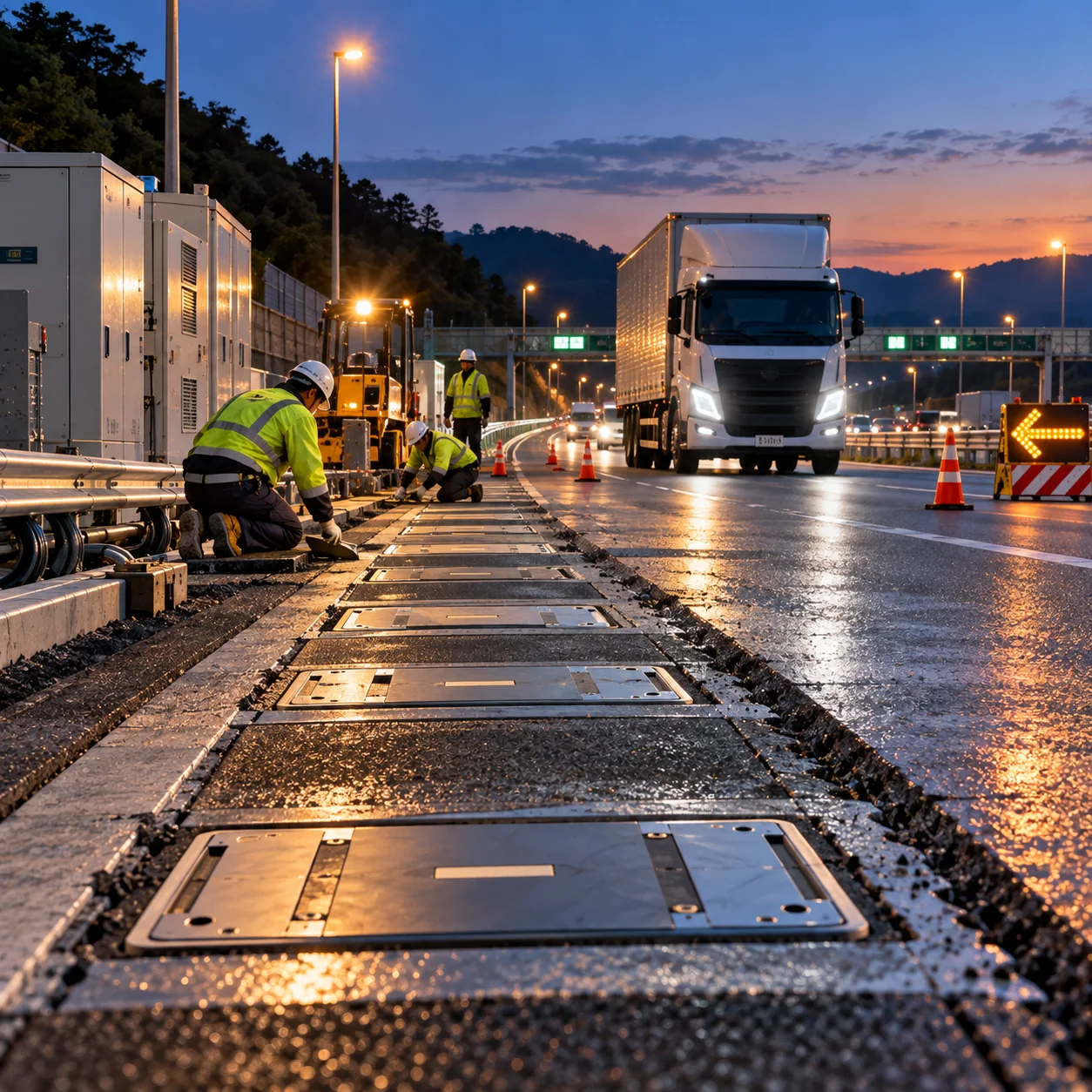
The system splits into three parts, and the division of labour says a lot about how in-road charging will be built. Taisei Corporation supplies the ground DC power supply. Honda R&D developed a DC distribution based ground assembly system that links multiple embedded power transmitters, along with the receiver unit fitted to the vehicle. Taisei Rotec handles construction methods for the charging road.
That mix of automaker, general contractor and paving specialist is the point.
Dynamic charging is a road construction project as much as an electrical one. Honda says it has worked on dynamic wireless power transfer since 2021, and its joint research with Taisei on the road system began in 2025.
The Engineering Is Built for 20 Ton Trucks
Honda framed the work around three practical problems. Embedded units and pavement must survive large vehicles with a gross vehicle weight of approximately 20 tons. The DC supply must deliver high power with fast, stable response. The hardware also has to be practical to install and upgrade.
The answers are specific. Each ground unit integrates the inverter and coil into a single dynamic charging unit, which Honda describes as a world first based on its own research as of the end of September 2026. The DC distribution layout simplifies the wiring buried in the road, cutting component counts and installation work. Units are designed to fit existing pavement through milling and embedding, which also eases future resurfacing.
Installation cost has always been the hard question for in-road charging.
A design that slots into milled pavement, rather than demanding a rebuilt roadway, goes straight at that question.
A Staged Path From Test Track to Expressway
The partners have already run experiments on a test roadway at the Taisei Group’s T-FIELD/SATTE facility, validating power transfer, pavement structures and construction methods for demonstrations with large commercial vehicles. The next steps, as set out in Honda’s announcement, are staged:
- A new test roadway at T-FIELD/TAMRA, to be built in late 2026
- Long-term durability testing equivalent to 1 million wheel loads at 49 kN per wheel, using actual vehicles
- Dynamic charging performance tests and measures to control electromagnetic field leakage
- Verification of power transfer of up to 150 kW for large commercial vehicles
- Reliability testing for vehicles at high speeds
- Public road demonstrations from Japanese fiscal year 2027, including the NEXCO East Tateyama Project
That sequence matters for anyone weighing the technology. Durability over a million wheel loads is the kind of evidence highway agencies will want before letting embedded hardware into a live lane.
Why Canadian Fleets and Road Authorities Should Watch
Canada’s public charging build has centred on stationary sites, and it is still growing quickly. Electric Autonomy, analysing Natural Resources Canada data as of 25 March 2026, counted 8,431 public DC fast charging ports, up about 33.6 per cent year over year, within a total of at least 39,654 public ports.
That network will keep doing most of the work. In-motion charging is best understood as a possible complement on the busiest freight routes, where a truck drawing power while moving could carry a smaller battery or spend less time parked at a charger.
For Canadian operators, utilities and transportation ministries, two questions are worth starting on early.
Which corridors carry enough repeat heavy truck traffic to justify electrifying a lane?
Who owns and operates the asset when the charger is part of the road?
Honda’s own direction points toward partnership. The company says it plans to pursue co-creation beyond the automotive industry, including road infrastructure businesses, government agencies and energy businesses. In Canada, that list maps naturally onto the provincial utilities and transportation ministries that already shape highway charging.
The Road Starts to Behave Like Part of the Grid
The DC distribution architecture also matters to utilities. Feeding a string of embedded units from a central DC supply changes where load appears on the network, from a single high power site to a draw spread along a route. Planning that load will call for the same coordination between grid operators and transport agencies that corridor fast charging hubs already require.
Honda ties the work to its goal of carbon neutrality by 2050. The nearer goal is narrower and more useful: proving that a heavy truck can pick up meaningful power on a public expressway, day after day, without wearing out the road.
Chargers have spent a decade moving closer to where vehicles stop. The next step is meeting them where they never stop at all.