Some of the most consequential charging decisions in Canada are being made in council chambers.
According to a survey Electric Autonomy published on September 28, more than 60 municipalities and two provinces now require new buildings to install EV charging or to provide rough-ins for future chargers. That is roughly a 20 per cent increase from 2024.
These rules rarely make headlines. They do not come with ribbon cuttings or megawatt figures. What they do decide is whether a large share of future EV drivers will be able to plug in where they live.
That change matters.
The Map Is Filling In From the West Coast
British Columbia leads by a wide margin, with 33 municipalities carrying EV-ready requirements, according to Electric Autonomy’s EV-Ready MURB Tracker. Ontario follows with 17. B.C. and Quebec are the only provinces with EV-ready legislation at the provincial level.
Drive Tesla Canada, reporting on the same data on September 29, counted more than a dozen municipalities that have added requirements since 2024. Momentum is building city by city rather than through a single national rule.
The gaps are just as easy to see. Nunavut, the Northwest Territories, Yukon, Prince Edward Island, Nova Scotia, New Brunswick, Manitoba and Saskatchewan have no EV-ready requirements at either the municipal or provincial level. Calgary, St. John’s and Halifax have no formal bylaws, but Electric Autonomy reports that all three are considering future steps through proposals.
That puts three large markets on the list of likely next adopters.
Apartment Residents Are the Drivers Public Charging Cannot Fully Serve
According to Drive Tesla Canada’s reporting, 34 per cent of Canadian households live in apartment buildings. For many of them, owning an EV still depends on whether there is somewhere to charge in the parkade.
Electric Autonomy is direct about the problem: “Lack of charging is a common problem and barrier to EV adoption” for residents of condos and multi-unit residential buildings. The same is true in stratas, townhouses and semi-detached homes, where neighbours and boards sometimes resist charger installations because of cost or a lack of information.
Public fast charging can fill part of that gap. It cannot replace the overnight Level 2 session that makes EV ownership cheap and easy for detached homeowners. A driver who charges at home uses the public network for road trips. A driver who cannot charge at home relies on it every week, and that tends to make EV ownership feel harder than it needs to be.
EV-ready rules deal with that problem before anyone moves in.
The Cheapest Charger Is the One Planned Before the Concrete Is Poured
The economics behind these bylaws are simple. According to Drive Tesla Canada, installing charging infrastructure during construction costs three to four times less than retrofitting an existing building.
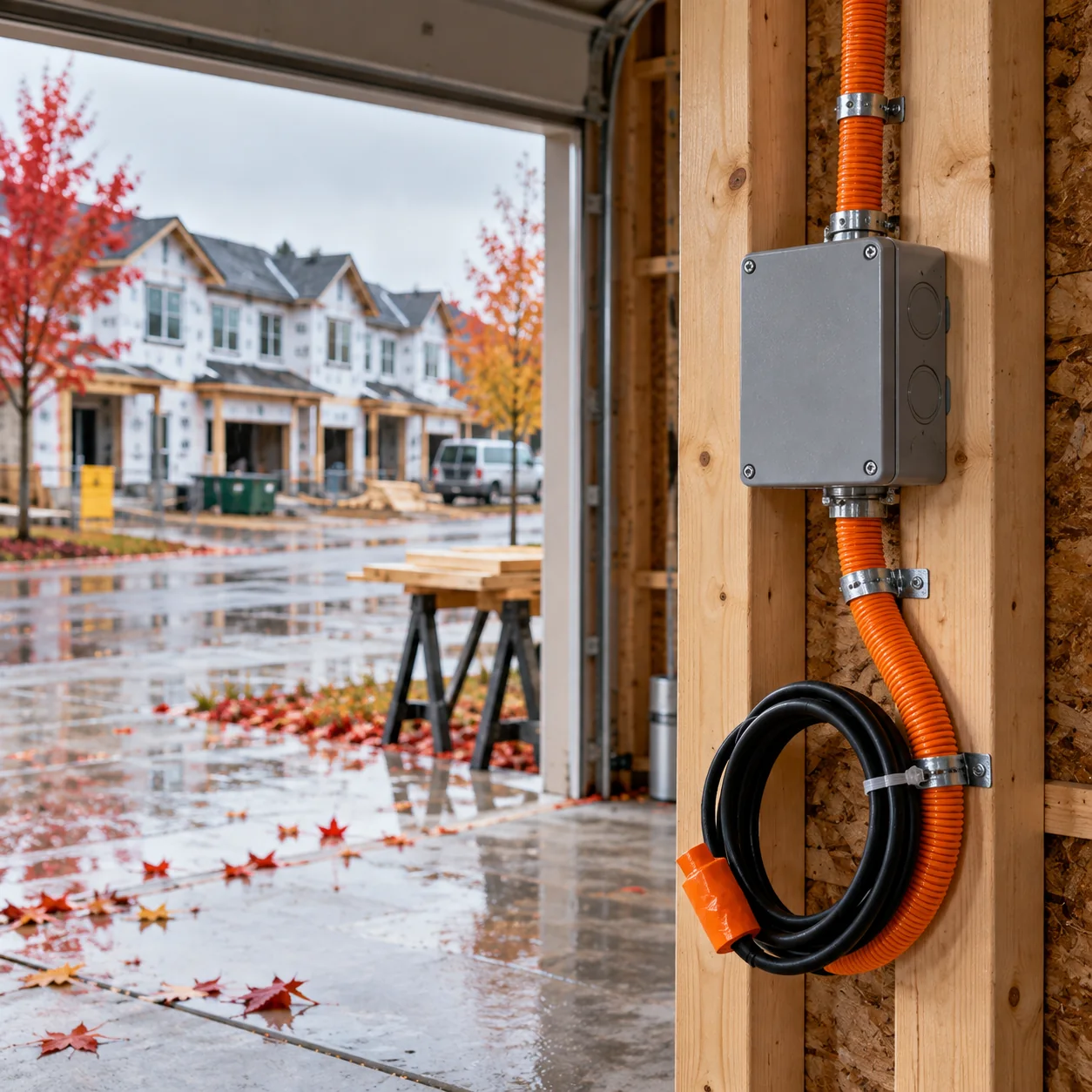
Putting in conduit, panel capacity and electrical room space during construction is a line item. Adding them later means trenching, coring through slabs, upgrading service and winning a strata vote. Each step adds cost and delay, and any one of them can stop a project.
Who pays to open the walls later?
And how many residents choose a gasoline car while they wait?
Every new building that goes up without a rough-in adds to the retrofit bill that owners, condo corporations and funding programs will eventually have to pay. Each building that goes up EV-ready takes that cost off the table for the life of the structure.
A New Pipeline of Sites for Operators, Developers and Utilities
For developers, EV readiness is becoming something designers plan for from the start, not an amenity added at the end. For charging providers, every EV-ready building is a site where the hardest and most expensive work is already done. What remains is hardware, software, billing and service, which is where networked Level 2 providers and managed-service operators make their money.
For utilities, the shift brings a planning question. Thousands of residential parking stalls wired for Level 2 charging add up to meaningful evening load, and load management inside the building will shape how much new service capacity each project actually needs.
The buildings that get the most out of these rules will be the ones that plan for the following from day one:
- Electrical capacity sized with load management in mind
- Clear ownership and billing models for shared parkades
- Networked chargers that can meter and allocate costs per resident
- A defined upgrade path from rough-in to energized circuit
- Early utility coordination on service size during permitting
- Resident and board education to head off objections to cost
A Patchwork Today, a Template for the Next Adopters
The uneven map does create friction. A builder working in Surrey, Toronto and Halifax faces three different sets of expectations, and drivers in eight provinces and territories have no EV-ready requirements to rely on at all.
But the patchwork also gives other jurisdictions something to copy. More than 60 municipalities have now written, adopted and applied EV-ready requirements. Calgary, St. John’s and Halifax can take what has worked in those communities instead of starting from scratch, and provinces without legislation can look to B.C. and Quebec.
That makes the next round of adoption easier than the last.
Canada’s charging debate tends to focus on highway corridors and kilowatt ratings. The quieter work of making sure new homes come wired for EVs may matter just as much for long-term adoption.
Fast chargers get the headlines. Conduit in the parkade is what lets condo residents charge at home.