Fast charging is moving to where people already park.
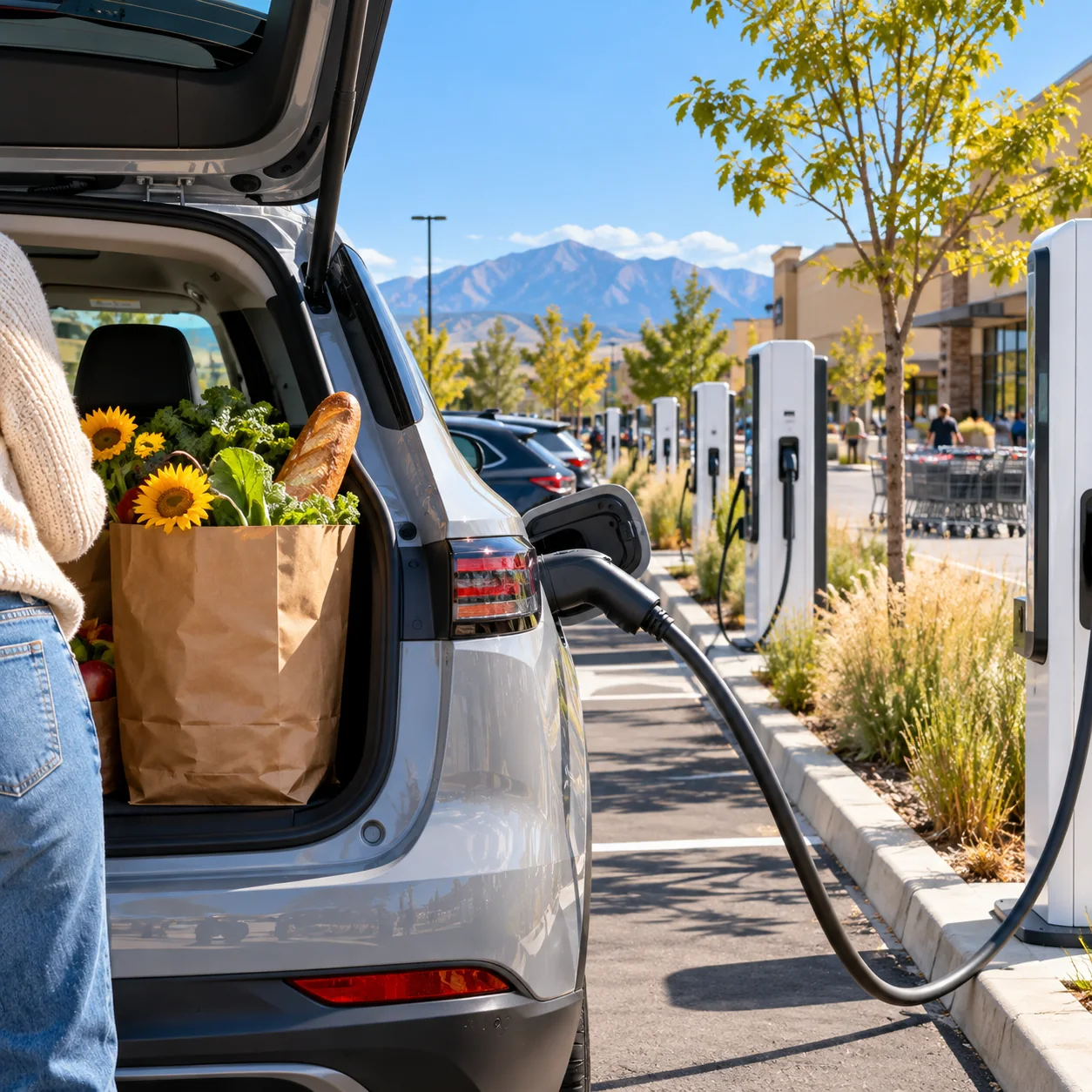
On September 9, EVgo and Regency Centers announced an expanded national partnership that will add more than 400 new fast charging stalls at Regency’s grocery-anchored shopping centres across the United States. EVgo already operates more than 150 stalls at Regency properties, and the companies expect the build-out to grow Regency’s EV charging footprint by more than 20 per cent.
The new sites are planned for metropolitan areas in Colorado, Florida, Illinois, New Jersey, New York, Pennsylvania, Texas, Virginia and other states, with up to 24 high-power chargers at each location.
The headline is the stall count. The more important signal is the siting logic behind it.
A Six-Year Partnership Moves Into Scale Mode
The relationship is not new. EVgo installed its first charger at a Regency centre in 2020, and the two companies have spent the years since building out a portfolio of more than 150 stalls. Adding another 400 takes the combined footprint past 550 stalls and turns a working relationship into a national deployment program.
Regency is an S&P 500 real estate investment trust that specialises in suburban, grocery-anchored properties. EVgo, according to the companies’ announcement, operates more than 1,200 fast charging stations across 47 states.
That pairing matters.
A landlord controls the parking field, the electrical rooms, the tenant relationships and the approvals needed to change a site. A charging operator brings hardware, software, network operations and the customer relationship with drivers. When the same two parties repeat that arrangement across dozens of properties, the friction of site acquisition falls and each new deal starts from a template rather than a blank page.
Dwell Time Is the New Site Selection Metric
The case for grocery-anchored charging rests on a simple number. As reported by EVChargingStations.com, the average American household visits a grocery store two to three times a week and stays about 23 minutes per visit. EVgo says its chargers can fully charge some vehicles in as little as 15 minutes.
Why build where drivers have to wait?
Why not build where they already stop?
Highway sites serve trips. Grocery sites serve routines. A driver who charges during a weekly shop is not making a special journey for electricity, and that changes both the user experience and the utilisation profile of the station. The same coverage noted research indicating that roughly half of drivers who stop at these sites go into adjacent stores or restaurants, which gives the property owner a direct commercial reason to host the equipment.
“EV drivers are looking for convenient charging options where they already spend their time, like grocery-anchored shopping centers,” said Scott Levitan, EVgo’s executive vice president of growth.
Landlords Are Turning Parking Into Infrastructure
For retail real estate owners, fast chargers are becoming part of the property offer, alongside anchor tenants, access and parking. A charging bay that brings a shopper back twice a week is an asset that supports tenant sales and occupancy.
Mark Peternell, Regency Centers’ vice president of sustainability, said expanding the EVgo partnership grows Regency’s EV charging footprint and gives more drivers reliable, convenient access to fast charging.
The structure also divides risk sensibly. The landlord supplies the location and the traffic. The operator carries the technology, the uptime obligation and the pricing. Neither has to become an expert in the other’s business, and that division of labour is what allows a program to scale beyond a handful of showcase sites.
What It Means for Canadian Developers and Property Owners
Much of the Canadian discussion about public fast charging has focused on highway corridors, utility-led networks and federal and provincial funding rounds. The EVgo and Regency expansion points to a complementary model: suburban retail plazas, which exist in almost every Canadian community, serving drivers who charge as part of their weekly routine.
For property owners, charge point operators and program applicants considering the same approach, the practical questions are clear:
- Available utility capacity at the site and the lead time for service upgrades
- Stall counts sized for repeat weekly visits rather than one-off trips
- Placement that keeps chargers visible without crowding anchor tenant parking
- Long-term agreements that cover hardware refresh and uptime commitments
- Shared data between operator and landlord on dwell time and on-site spending
- Winter readiness, including snow clearing and cable management at outdoor stalls
None of these are new problems. What the Regency deal shows is that a large landlord and a national operator have found enough answers to commit to hundreds more stalls.
The Next Test Is Execution
The companies did not publish a completion timeline. Delivering more than 400 stalls across at least eight states means utility interconnections, permitting and construction at many properties, and a site with up to 24 high-power chargers is a meaningful electrical load for any local distribution network.
That makes execution critical.
If the sites perform as the dwell time data suggests, grocery-anchored fast charging could become a standard format for retail real estate across North America, and a template that Canadian landlords and operators can adapt to their own markets and climate.
Highway chargers made long trips possible. Grocery-anchored chargers make everyday EV ownership routine.