Airports are turning into some of the largest parking-based charging sites in Canada.
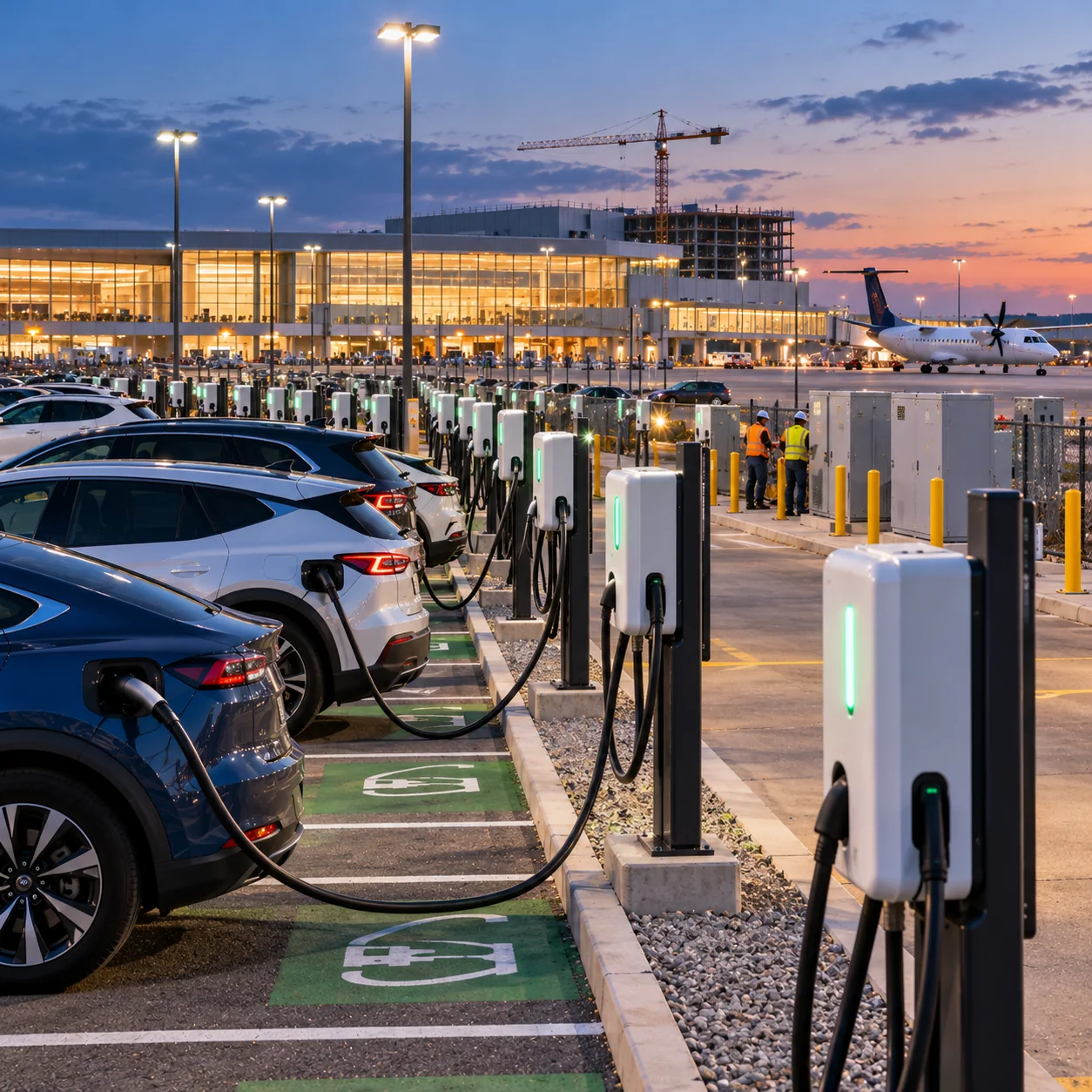
On October 15, 2026, Wallbox and Quebec-based edp électrique announced that 120 Wallbox Pulsar Pro chargers are now operating at the YHU Terminal of Aéroport métropolitain de Montréal (MET) in Longueuil. The chargers serve employees, visitors and airport operations staff. Another 48 are planned once a new building under construction at the site is finished, which would bring the total to 168 charging points.
The numbers are notable for a regional airport. The design behind them is more notable still.
Power Sharing Made the Scale Possible
The Pulsar Pro is a Level 2 charger with a maximum output of 11.5 kW, according to EV Infrastructure News. The companies did not disclose the power settings used at the airport, but the key feature is Wallbox’s Power Sharing function, which divides the available electrical capacity across groups of chargers rather than reserving full output for every connector.
That choice matters.
A car parked for a full shift or a multi-day trip does not need a fast charge. It needs a reliable one. Sharing power across a cluster lets a site put a plug in front of far more parking spaces without paying for a service upgrade sized to every charger running at maximum at the same moment. EV Infrastructure News describes the built-in power sharing as what made the scale of the deployment possible.
Network management and payments run on Foresta’s platform, which gives the airport a single view of the whole site. The companies say the system can scale with demand, which is the point of building in phases.
Airports Are Long-Dwell Sites by Design
Few locations match an airport for parking time. Employees park for eight or more hours. Travellers leave vehicles for days. Operations staff move between parking and airside work throughout the day.
Those patterns line up neatly with Level 2 charging economics. Low-power hardware is cheaper to buy and install, it places less stress on the local grid, and it can still deliver a full charge across a typical stay.
Wallbox chief business officer Ignasi Alastuey framed it as a shift in where charging is heading: “Transport hubs such as airports are an important part of the next phase of EV charging infrastructure.”
The MET site also has growth behind it. Porter has made the airport its Montréal hub and built a 21,000 square metre commercial terminal to support Porter and Pascan flights, according to Drive Tesla Canada. More flights mean more employees, more visitors and more parked cars.
A Quebec Supply Chain Delivered the Project
The installation drew on several partners. edp électrique coordinated integration and worked between the airport, manufacturers and distributors. EG Électrique handled electrical services, Westburne supplied electrical distribution, and Foresta provided the management software, according to the Wallbox release.
edp électrique sales representative Sabryna Barabé-Favreau called the project “a strong example of what can be achieved through close collaboration between all stakeholders.”
That coordination is often the hardest part of a large parking deployment. A site with more than a hundred charging points touches electrical design, procurement, construction scheduling and software onboarding at once, all while the airport keeps operating.
What Site Hosts Can Take From the MET Model
The airport’s approach offers a template for other large Canadian parking operators, from hospitals and universities to industrial campuses and transit park-and-ride lots. The practical lessons are clear:
- Match charger power to how long vehicles actually stay parked
- Use load management to fit more ports onto existing electrical capacity
- Phase the build so new buildings bring new chargers with them
- Put the whole site on one management and payment platform
- Name a single integrator to coordinate contractors and suppliers
- Plan for employees and fleet staff as well as visitors
How many large parking lots across Canada could add charging this way without a major grid upgrade?
How many are already planning for it?
Phase Two Is Already Written Into the Plan
No completion date has been given for the new building or the 48 additional chargers. What the airport has done is commit to a second phase now, and tie charging growth directly to new construction rather than retrofit it later.
That is the cheaper and faster way to build. Conduit, panels and load management installed during construction avoid trenching an occupied lot after the fact.
Fast charging along highways gets most of the attention in Canada. Destination charging at large, long-dwell sites does much of the daily work, and MET has shown how to deliver it at volume.
Fast chargers keep drivers moving. Parking lots like this one keep them charged.