Charging infrastructure is heading underground.
On November 13, Sudbury MP Viviane Lapointe announced $300,000 in federal funding over two years for Cambrian College to build what the college describes as Canada’s first mobile high-power charging system for battery-electric vehicles working in underground mines. The college’s research arm, Cambrian R&D, is developing the prototype with Eaton, the power management company, which is supplying the components.
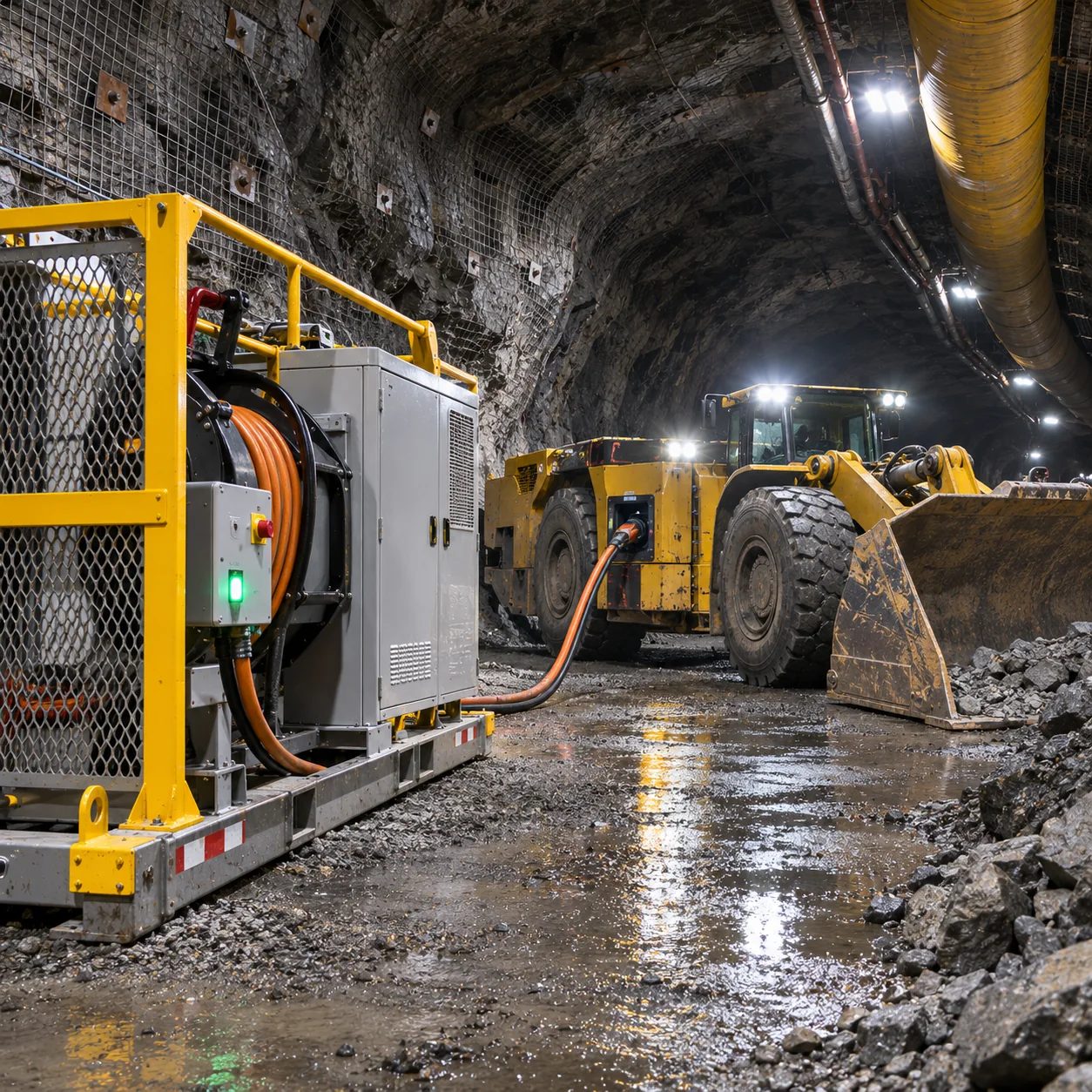
The concept is simple. Instead of asking heavy mining equipment to travel back to a fixed charger, the charger travels with the work.
A Charger Built for a Moving Worksite
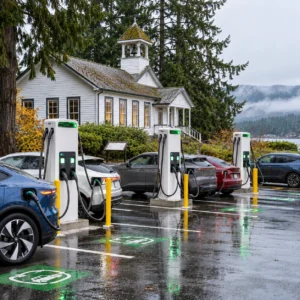
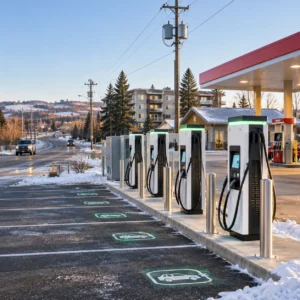
Most charging infrastructure assumes a fixed address. A depot, a highway corridor or a parking structure stays where it was built, and vehicles come to it.
An underground mine does not work that way. As a mine advances, the active work area moves further from the infrastructure installed when development began, and every kilometre of travel back to a charging bay is time a loader or haul truck is not producing.
Cambrian’s answer is a rugged, skid-mounted system that can be relocated underground as the mine advances, according to the college. It combines three parts: a large battery, a fast charger and a mine-ready enclosure. The goal is to give vehicles and equipment enough energy to return safely to home base and to cut the downtime that comes with distance-related charging gaps.
“We all know how frustrating and inefficient it is not to have a charger handy,” said Kristine Morrissey, president of Cambrian College, as reported by Canadian Mining Journal. “Imagine that on an industrial scale. That’s what this project is all about.”
Sudbury Is the Right Place to Prove It
The project sits in one of the world’s most established hard rock mining regions, and Cambrian frames it squarely around the transition away from diesel underground.
The college says the technology is designed to lower greenhouse gas emissions, improve underground air quality and open commercialization opportunities for Canadian companies. Morrissey tied it directly to the national critical minerals push: to advance the electrification of mining in Canada, she said, “you need to have critical infrastructure in place to make that happen.”
That is the core point for the charging industry.
Battery-electric mining equipment only works if energy is available where the equipment operates. Without it, operators either oversize batteries, accept lost production time or keep diesel units in the fleet as a backup.
Storage Is Becoming Part of the Charger
The most transferable idea in the design is the pairing of a large battery with the fast charger. A battery-buffered unit can deliver high power to a vehicle without needing an equally large electrical connection at the point of use.
Eaton sees the project in those terms. Chris Fluit, senior vice president and general manager at Eaton, said in the college’s release that “partnership across government, education and industry is essential to advancing practical solutions,” and noted that the work extends beyond the charger itself to power infrastructure and energy storage.
Surface charging operators will recognise the logic. Battery-backed chargers are already used to work around slow utility upgrades at constrained sites. Underground, the same approach solves a different problem: getting high power to a location that keeps changing.
Training the People Who Will Install and Run It
Cambrian students will design and build the prototype using parts supplied by Eaton, according to Canadian Mining Journal. The college describes the project as a way to train students in advanced electrification and clean energy technologies while solving a live industry problem.
“Cambrian R&D has mastered the art of partnerships,” Lapointe said in the announcement.
Workforce is a quiet constraint across Canadian charging deployment, and heavy-duty, harsh-environment charging needs specialists. Building that skill base in a mining centre, alongside the companies that will buy the equipment, shortens the path from prototype to field use.
What Fleet and Site Operators Should Watch
The prototype is a two-year project, and its real test will come in operation. For mine operators, equipment makers and charging suppliers, a few questions will decide how quickly mobile high-power charging moves from pilot to standard practice:
- How much energy the onboard battery can deliver between refills
- How quickly the unit can be relocated and safely recommissioned
- How the enclosure holds up to underground dust, water and vibration
- How the system recharges itself from the mine’s existing power network
- Whether the design can be standardised across equipment makers
Morrissey summed up the stakes plainly: the project “could have huge implications for the efficiency and adoption of electrified mining.”
The lessons will not stay underground. Remote work camps, construction sites and off-grid fleet yards across Canada face the same challenge of delivering high power where a permanent connection does not exist.
Fixed chargers built the first phase of electrification. Chargers that move with the work will help build the next.