BC Hydro is getting more cars onto every charger it installs.
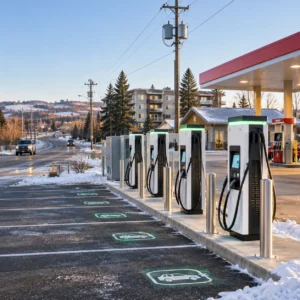
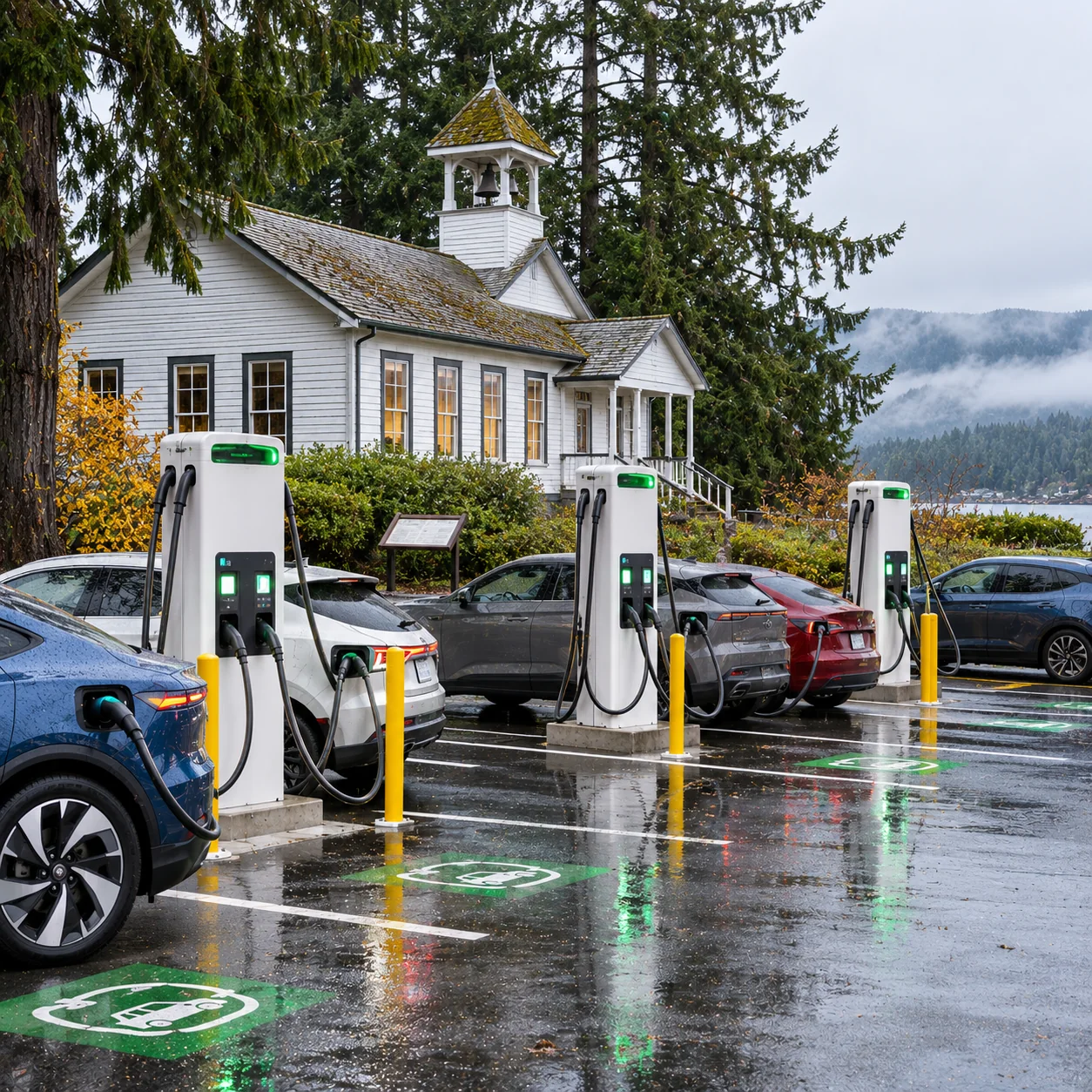
On November 20, the utility opened a fast charging site at the Heritage School Museum on West Saanich Road in Brentwood Bay. The site uses three 180 kW chargers that can serve up to six vehicles at once. A day earlier, on November 19, BC Hydro said it had expanded its site at the Coquitlam Superstore on Lougheed Highway so that up to eight EVs can now charge at the same time on four 180 kW units.
Neither announcement is large on its own. Together they show a clear design choice taking hold across the province’s largest public charging network, and it is one that other Canadian operators are watching.
One Charger, Two Cars
The common thread is power sharing. According to BC Hydro, each 180 kW charger at both sites can split its output to serve two vehicles, for example delivering 90 kW to each car. When only one vehicle is plugged in, it can draw more.
That changes the arithmetic of a site.
A traditional fast charging layout pairs one dispenser with one parking stall. Every new stall means another cabinet, another set of power electronics and often another increment of grid capacity. A shared unit lets an operator double the number of stalls without doubling the hardware. Drivers who arrive at a busy site are far more likely to find an open plug, and the operator gets more sessions from the same electrical connection.
BC Hydro says a typical EV can add up to 180 km of range in about 10 minutes at these sites. For most drivers stopping at a community centre, a museum or a grocery store, that is more than enough.
Three Plugs for Every Driver
Both sites offer CCS, CHAdeMO and NACS connectors. That combination matters as the market shifts. Tesla drivers can plug in without an adapter, owners of newer vehicles from other automakers moving to NACS are covered, and drivers of older CCS and CHAdeMO models are not left behind.
For a public utility, serving every vehicle on the road is the point. A network built for one connector risks stranding part of its customer base. A network that carries all three can serve visitors, fleets and residents alike for years without retrofits.
Building Density Where Drivers Already Go
The two sites illustrate two different ways to grow.
Brentwood Bay adds coverage on the Saanich Peninsula. According to BC Hydro, the utility now operates eight charging sites in Greater Victoria with 57 charging ports combined, stretching from Sidney and Saanich to downtown Victoria, the Ogden Point cruise ship terminals and Esquimalt. The new site mirrors the layout BC Hydro used at the Archie Browning Sports Centre in Esquimalt, which also serves six vehicles on three 180 kW units.
Coquitlam does something different. Rather than opening a new location, BC Hydro added capacity at an existing retail site, where demand is already proven. The utility says its sites now provide 74 charging ports across the Tri-Cities region of Coquitlam, Port Coquitlam and Port Moody.
Expanding a busy site is often the most efficient dollar an operator can spend. The land agreement, the utility connection and the customer habit are already in place.
British Columbia Gives Operators a Strong Base to Build On
The province offers fertile ground for this approach. According to Paren’s report on Canadian fast charging for the third quarter of 2026, British Columbia recorded utilization of 13.1%, the highest of any province, along with an average price of about $0.41 per kWh, the lowest among the priced provinces. Paren counted 18 new fast charging stations in British Columbia in that quarter, and BC Hydro added 22 new ports.
Nationally, Paren reported 2,740 fast charging stations and 9,615 ports as of September 30, 2026, with ports up 26.8% year over year. The largest share of new ports, 42%, fell in the 150 to 249 kW band, which is where BC Hydro’s 180 kW units sit.
The longer runway is just as clear. In February 2025, BC Hydro said more than 180,000 EVs were on the province’s roads and projected 700,000 to 900,000 within 10 years. Its chargers are funded in partnership with the Province of B.C. and Natural Resources Canada.
What Other Canadian Operators Can Take From This
The BC Hydro model offers a practical template for networks across the country, particularly those planning ZEVIP funded projects:
- Use power sharing units to add stalls without adding equal grid capacity
- Offer CCS, CHAdeMO and NACS so no driver is turned away
- Expand proven retail sites before chasing new addresses
- Pair community host sites such as museums and recreation centres with regional coverage goals
- Standardize one site layout so each new location is faster to design and build
None of these ideas is exotic. What sets BC Hydro apart is that it is applying them consistently, site after site, across one of the most active charging markets in Canada.
The Next Gains Come From Smarter Sites
Canada’s early charging buildout was about putting dots on the map. The next phase is about how much each dot can do.
Six cars on three chargers in Brentwood Bay. Eight cars on four in Coquitlam.
The network that grows fastest may be the one that gets the most out of every connection it already has.