Canada’s charging program has a future again.
The federal budget tabled on November 5, 2026 proposes to renew the Zero Emission Vehicle Infrastructure Program with $587 million over five years, starting in 2027-28. According to coverage by Auto123 and Drive Tesla Canada, the money is meant to support more than 55,000 additional chargers, a mix of Level 2 and DC fast charging, in the places where coverage is thinnest.
Ottawa says it has already supported more than 50,000 chargers. The renewal would roughly double that federally backed footprint. For developers, site hosts and utilities, the bigger change is time: a funding line that now reaches into the next decade.
A Five-Year Runway Changes How Projects Get Planned
Charging projects rarely fit inside a single fiscal year. Site selection, utility service requests, transformer orders and permitting can stretch across several construction seasons, and Canadian winters shorten the window further.
A multi-year commitment lets builders plan a pipeline instead of a one-off application.
Drive Tesla Canada reports that the budget expects 58,874 chargers funded through existing ZEVIP money to be operational or planned by 2028-29, before any of the new investment is counted. The renewal stacks the next wave on top of that base, giving installers, equipment suppliers and electricians clearer visibility on demand.
The wider package totals just over $634 million. Beyond the ZEVIP renewal, it includes $45 million over five years for charging research and development through Natural Resources Canada and $2.2 million over five years to move federal fleets to zero-emission vehicles, according to Auto123 and EV Infrastructure News.
The Money Is Aimed at the Gaps, Not the Busiest Corridors
Auto123 reports that the funding prioritises rural routes, multi-unit residential buildings and public workplaces. EV Infrastructure News adds that the budget sets regional targets so public charging is not confined to the most populous areas.
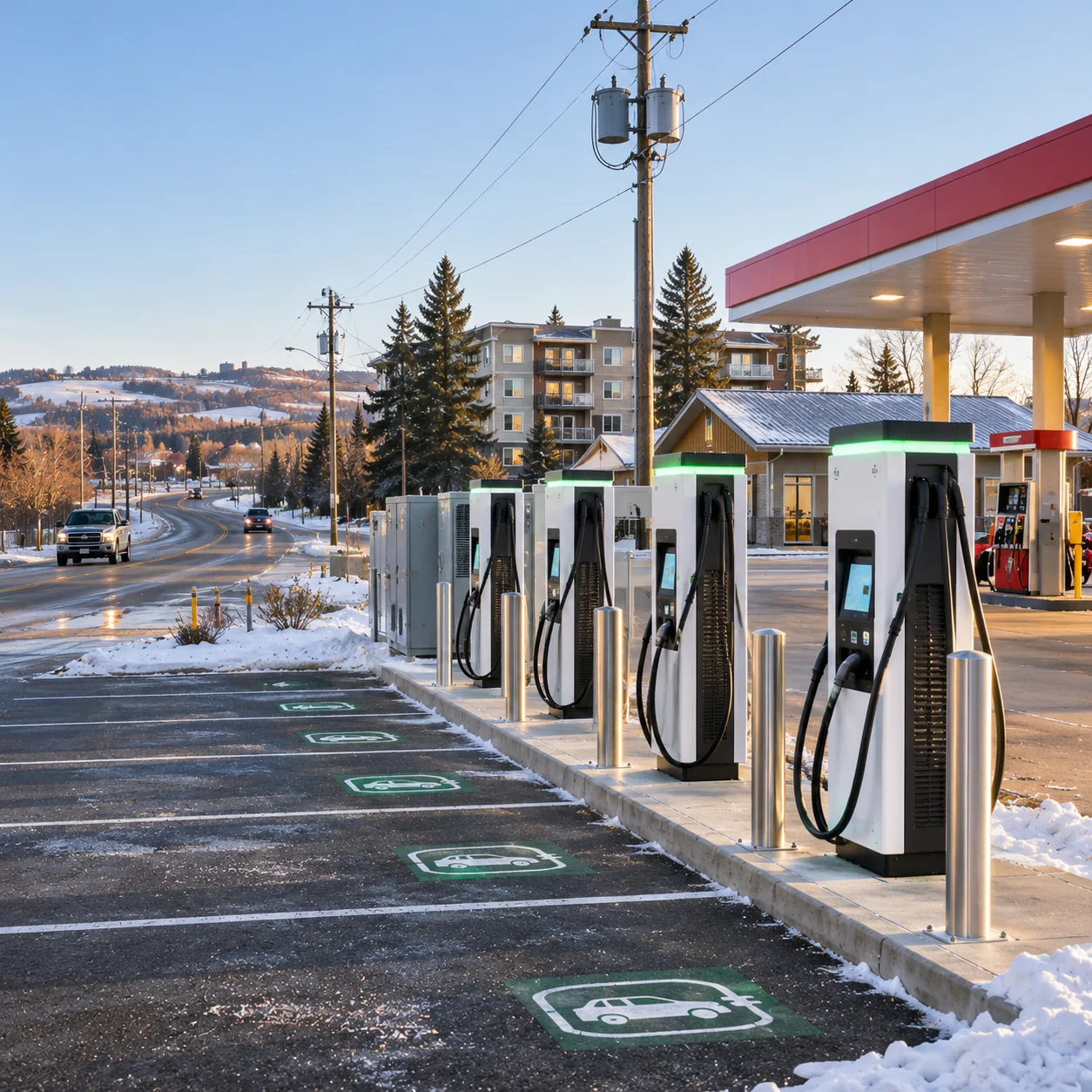
That focus lines up with what the network data shows. Paren’s report for the third quarter of 2026 counted 2,740 fast-charging stations and 9,615 fast-charging ports in Canada, with 103 new stations added in the quarter. Quebec added 49, Ontario 22 and British Columbia 18, and together those three provinces accounted for 86.4 percent of new stations.
Utilization tells the same story. British Columbia led at 13.1 percent and Ontario followed at 11.5 percent, while the Northwest Territories sat at 0.3 percent and Yukon and Saskatchewan at 3.9 percent, according to the Paren figures reported by MobileSyrup.
Where will the next 55,000 chargers do the most good?
And who is ready to build there?
Apartment Towers and Workplaces Become Core Markets
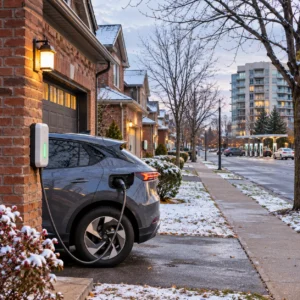
Naming multi-unit residential buildings and workplaces as priorities matters for a large part of the market. Drivers without a private driveway depend on chargers at home in a shared garage or at the place they park all day, and those sites come with their own engineering problems: limited panel capacity, shared ownership and long approval chains.
Federal support aimed at those sites can tip the economics for property managers and condo boards that have been waiting for a clearer business case. It also opens steady work for load management providers, electrical contractors and charge point operators that specialise in shared parking.
The Grid Side of the Budget Helps Too
The charging line sits next to broader electricity measures that matter to anyone waiting on a grid connection. EV Infrastructure News reports that the budget extends the Clean Technology and Clean Electricity investment tax credits from 2034 to the end of 2040, and expands the Clean Electricity credit to cover high-voltage intra-provincial transmission lines.
More transmission and distribution capacity is what ultimately shortens energization timelines for fast-charging hubs and depots.
Consumer incentives continue as well. The Electric Vehicle Affordability Program still offers up to $5,000 for eligible battery-electric vehicles and up to $2,500 for plug-in hybrids, and runs to March 31, 2031 at the latest. The budget adds no new rebate funding, which leaves infrastructure as the main new federal lever.
What Charging Builders Should Prepare Before 2027-28
The renewed funding starts in the 2027-28 fiscal year, which gives the industry time to get ready. Operators and site hosts that want a share of the next round should be working now on:
- Site pipelines in rural corridors and underserved regions
- Electrical capacity assessments for apartment and condo buildings
- Early utility service requests for higher-power sites
- Workplace partnerships with employers and public institutions
- Uptime and maintenance plans for cold-climate operation
- Ownership and funding stacks that combine federal, provincial and utility support
The program details, including application windows and cost-share rules, will come from Natural Resources Canada. The direction is already clear.
The first 50,000 chargers proved the model. The next 55,000 have to reach the drivers it missed.