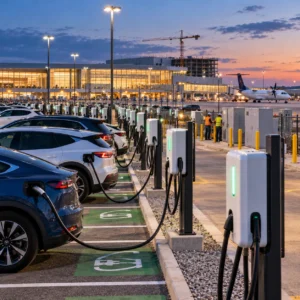
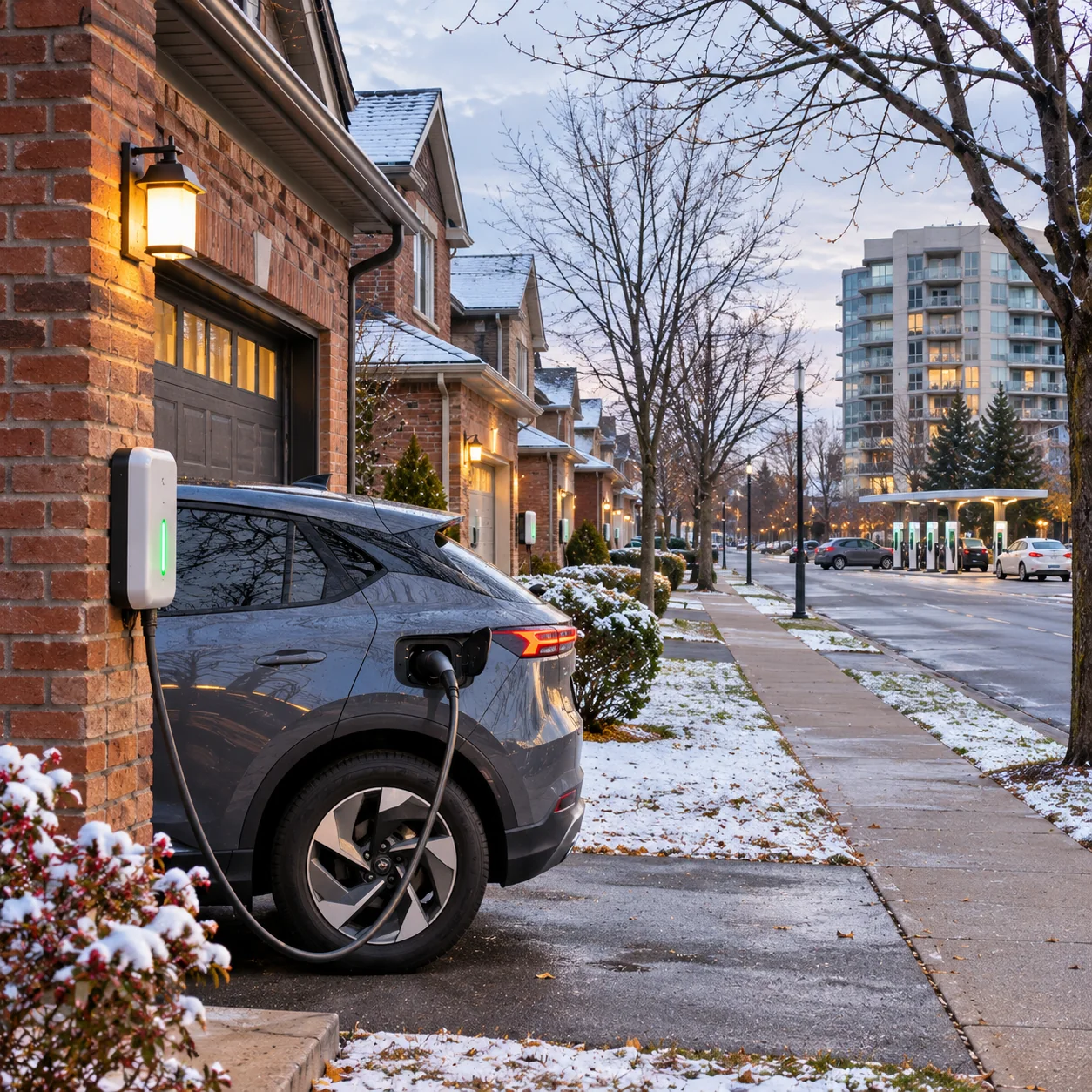
Canada’s charging buildout now has a number to plan around.
A new report from the Canadian Climate Institute, titled Leading the Charge and modelled for Natural Resources Canada, estimates that the country will need about 19 million charging ports by 2040 to support 21 million electric vehicles. Electric Autonomy reported the findings on October 30, 2026.
Today Canada has roughly 1 million chargers, private and public combined, and about 1 million EVs on the road. That puts the required growth at about 19 times the current base.
The headline figure is large. The more useful finding is where those ports will sit and who will pay for them.
The Home Charger Carries the Load
The modelling projects that 96% of the chargers needed by 2040 will be in homes.
That reshapes the size of the public challenge. Zoe Larkin, the report’s author and a senior research associate at the Canadian Climate Institute, told Electric Autonomy that most of the required chargers can be installed by households or the private sector.
The market is already moving in that direction. According to the report, about 70% of the public chargers in service today were built without federal funding.
That is a strong signal for investors.
Private capital has shown it will build charging where the business case holds. The task for policy is narrower than it first appears: fill the gaps the market cannot reach on its own, and let commercial operators scale everywhere else.
Public Networks Become a Targeted Business
Public charging still matters, but its role is becoming more specific.
The report identifies stretches of the National Highway System that run more than 65 kilometres without a fast charger, along with rural areas where low utilization makes it harder for private operators to turn a profit. It also notes that 87% of chargers funded through the Zero Emission Vehicle Infrastructure Program up to 2023 went to Ontario, British Columbia and Quebec.
Those findings point network operators and funders toward the same places: corridors, smaller communities and provinces that have seen less buildout so far. Dedicated rural funding sits among the report’s five recommendations, which gives operators a clearer view of where future public money is likely to flow.
Larkin also pointed out that the provinces that backed EVs and charging alongside Ottawa are the ones seeing the strongest results today. That makes provincial programmes a practical lead indicator for where the next wave of commercial sites will be built.
Multi-Unit Buildings Are the Clearest Opening
One gap in the data stands out.
About one third of Canadians live in multi-unit residential buildings, according to the report, but only 12% of EV owners do. That difference describes a large group of potential drivers who have not yet had easy access to home charging.
It also describes a market. Retrofitting a building for charging can cost three to four times more than making it EV-ready during construction, so the report recommends EV-ready requirements for new multi-unit buildings alongside dedicated funding for existing ones.
For charge point operators, property managers and installers, the multi-unit segment offers a defined customer base with a known access problem and a clear policy direction behind it. Firms that build repeatable retrofit models for condominiums and rental towers are well placed as that demand opens up.
Managed Charging Turns Home Demand Into a Grid Resource
Millions of home chargers raise an obvious question for utilities.
Can the grid carry the load?
The report’s answer is encouraging. Peak residential EV demand could fall by up to 48% if half of EV drivers join load management programmes. That turns the home charger into a flexible asset rather than a fixed burden on local distribution networks.
The report also tackles a cost that weighs on public operators. One British Columbia analysis it cites found that demand charges can account for as much as 80% of a charging operator’s electricity costs. Reforming those charges is another of the report’s recommendations, and progress there would improve site economics at exactly the low-utilization locations that need it most.
The opportunity breaks down along clear lines:
- Home charger hardware and installation at national scale
- Managed charging software and utility programmes
- Retrofit solutions for multi-unit residential buildings
- Corridor fast charging where highway gaps exceed 65 kilometres
- Rural sites supported by dedicated funding
- Rate design that reduces the weight of demand charges
A Plan Built Around the Market That Already Works
The report ties its projections to federal targets of a 75% EV share of new car sales by 2035 and 90% by 2040. Meeting them will take steady growth across every segment of charging.
What the modelling makes clear is that the bulk of that growth will come from households and private companies doing what they already do. Public effort can focus where it adds the most: corridors, rural communities, apartment buildings and the grid rules that shape operator costs.
Nineteen million ports sounds like a public works project. Most of it will be built one driveway at a time.