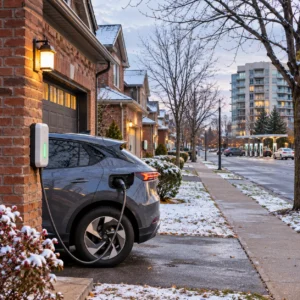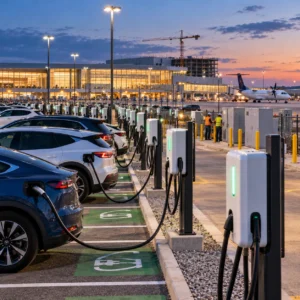

Canada has run plenty of vehicle-to-grid pilots. Now it is organising to scale them.
On October 20, 2026, Dunsky Energy + Climate Advisors announced the Canadian Vehicle-Grid Integration Alliance, a national group built to align standards, investment and deployment practices so that managed and bidirectional EV charging can move beyond small trials. According to Electric Autonomy, BC Hydro, Manitoba Hydro, Alectra and the Government of Nova Scotia are funding partners, with the Government of Canada, Electric Mobility Canada and the Vehicle-Grid Integration Council as strategic collaborators and General Motors in a supporting role.
That is three major utilities, two levels of government, the national EV industry association and an automaker at one table. For charging infrastructure, the line-up matters as much as the mission.
Two Technologies, One Grid Problem
The alliance covers two related tools. Managed charging lets a utility shape when vehicles draw power, moving load away from periods of grid stress. Bidirectional charging goes further, allowing a parked EV to send electricity back to the grid or power a home during an outage.
Both turn EV charging from a pure load into something a utility can plan around.
Philippe Dunsky, the firm’s founder and president, tied the effort to the scale of Canada’s electricity build. With the country preparing to double its grid, he told Electric Autonomy, “we’ll need every tool in the toolkit to do it affordably.”
Why Pilots Have Not Been Enough
Vehicle-grid integration requires industries with very different habits to coordinate. Utilities, automakers, charger manufacturers and regulators each move on their own schedules.
“They have very long planning lead times and they’ve never actually needed to work together before,” Mabel Fulford of Dunsky told Electric Autonomy. She described Canada as “only at the very beginning” of seeing the technology reach the market.
Standards are a large part of the timeline. Electric Autonomy reports that adopting a standard takes about 18 months after it is finalised. Every year of misalignment between vehicle, charger and utility requirements pushes real deployment further out.
That makes early coordination the cheapest kind of progress.
Aligning With the North American Market
One of the alliance’s stated aims is to harmonise Canadian vehicle and utility standards so that products designed for the United States can enter the Canadian market more easily. Canada’s vehicle market is roughly the size of California’s, according to Electric Autonomy, which gives manufacturers little reason to build Canada-specific hardware or software.
For charge point operators and fleet owners, that alignment would mean a wider choice of bidirectional-capable chargers and vehicles, and less custom engineering at each site.
The long-term ambition is simple to state. The alliance wants managed charging and bidirectional capability to be standard at the point of EV purchase, set up through a process that is “as easy as installing a dryer.”
Price Signals Are Already Arriving
Utilities are already giving drivers reasons to charge at the right time. The Ontario Energy Board’s new Regulated Price Plan rates take effect on November 1, 2026, according to Drive Tesla Canada. Under the Ultra-Low Overnight plan, power between 11 p.m. and 7 a.m. costs 3.7 cents per kWh, while the on-peak period from 4 p.m. to 9 p.m. costs 37.7 cents.
Utility programmes add to that signal. Drive Tesla Canada reports that Hydro One pays $100 in the first year and $50 a year after for its EV rewards programme, while Hydro Ottawa’s GridFlex pays $75 to enrol plus $20 a year.
Tariffs like these create the commercial foundation that vehicle-grid integration needs. What remains is making the hardware, software and utility systems talk to each other at scale.
What the Alliance Will Work on First
Partners will hold working sessions across several areas:
- Market alignment between automakers, charger makers and utilities
- Standards and interoperability
- Investment and regulatory pathways for scaling up
- Coordinated deployment and the customer experience
The first deliverable is an online VGI Knowledge Centre, led by Electric Mobility Canada and expected in the fall of 2026, according to Drive Tesla Canada. The alliance has not yet announced funding commitments or deployment targets, so the early work is about building a common framework that utilities and regulators can adopt.
Large vehicle-grid pilots are already running in the United Kingdom, Europe, Australia and the United States. Canada now has a structure for turning its own pilots into programmes.
Which utilities will be first to offer bidirectional charging as a standard product?
How quickly can regulators recognise EV batteries as a grid resource?
For the charging industry, the answers will decide whether chargers are valued only for the energy they deliver or also for the flexibility they provide.
Canada spent the last decade building places to plug in. The next decade is about what those connections can do for the grid.